Michel Favre
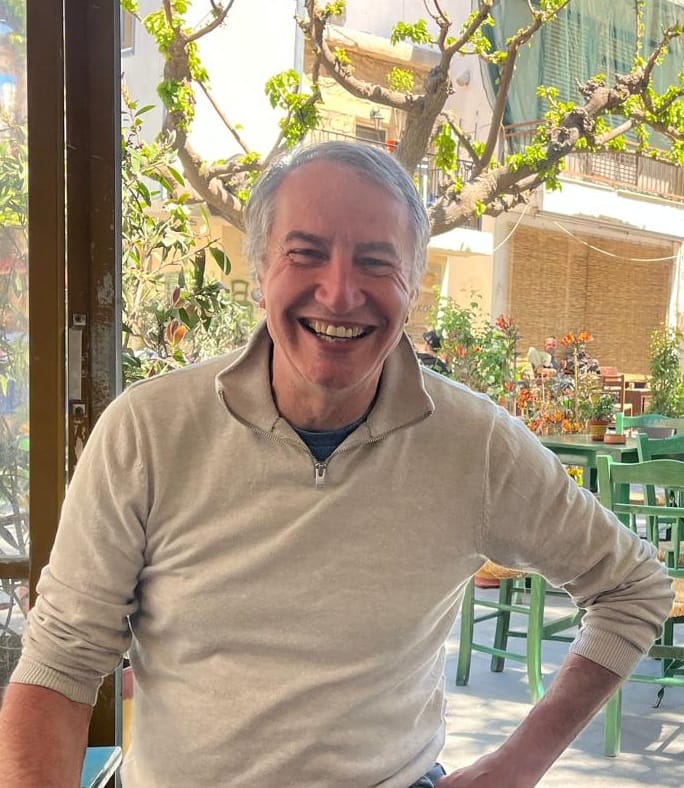
Michel Favre is an osteopath. He completed five years of osteopathy studies at the École Professionnelle des Ostéopathes du Québec (EPOQ).
In the early 1990s, he studied traditional Chinese medicine in Paris and at Guan An Men Hospital in Beijing. He then trained in Quebec in massage therapy, including Swedish and California massage, as well as lymphatic drainage, the Trager approach, and biorhythm techniques in fasciatherapy.
He practiced as a massage therapist for over 10 years in Quebec and has worked as an osteopath since 2015.
He also holds two energy techniques: La Trame® and Mary Magdalene energy harmonization sessions.
For several years, he has co-led seminars and retreats in Crete on biological decoding and personal development.
The La Trame® technique was developed by Patrick Burensteinas in 1990. He practiced it for around fifteen years, working with more than 20,000 people.
This technique is very gentle. It requires no manipulation. No psychological or psychoanalytical interpretation is carried out.
The practitioner makes no diagnosis.
The principle behind this treatment is to restore the body's original pattern. The sequence of 16 gestures, always the same, informs the body of what it needs to do, while leaving the initiative to the body itself.
This gentle technique involves the practitioner placing their hands on 16 points on the body of the person lying down, without applying any pressure.
This technique requires no manipulation, and the person remains fully clothed.
The session lasts between 40 and 60 minutes.
Sessions are typically given once a month for about 3 or 4 months. After that, the person can decide to stop, continue at the same pace, or continue until they have reached their goals.
The goal is to rebalance the flow of energy within the body. Sessions need to be spaced 3 to 6 weeks apart to allow the body to self-regulate.
It is possible to receive a La Trame session remotely.
The recipient contacts the practitioner, and together they agree on a date and time for the session. The practitioner explains to the recipient how a remote La Trame session works.
When the time comes, the recipient lies down in a quiet place where they know they won't be disturbed. A timer is then started.
Meanwhile, the practitioner sets up their table and space as if the recipient were physically present. They connect energetically to the recipient and carry out the treatment as though the recipient were there in person.
At the end of the session, the practitioner closes the energetic connection. When the timer goes off, the recipient gets up quietly and contacts the practitioner to share feedback on their experience.
Adapted from the book from Patrick Burensteinas, "La Trame, Se soigner par l'énergie du Monde"
Our bodies are made up of trillions of cells, organized with remarkable coherence — liver cells stay liver cells, bone cells stay bone cells, and everything holds together in its proper place. According to Patrick Burensteinas, this coherence is maintained by a kind of information blueprint, a pattern that tells each cell where it belongs and what it's meant to do — much like the "trame" (weave) of a tapestry holds its threads together in precise order. He calls this underlying pattern of the human body "La Trame": a quantum-like grid of information that organizes and maintains the structure of our cells.
At birth, each person's trame is set, and over the course of life, outside influences come to interfere with it.
The causes of disruptions or illness most often stem from our emotions. When they are too intense or poorly processed, they leave traces that hinder or block the proper flow of energy and information along our trame.
When you shake a rug from one end, you create a wave that travels across it. If a large stone is placed on it, the wave's movement will first be disrupted, and then the stone will gradually be pushed until it is ejected from the rug.
In the same way, information travels along the human body's "trame." The stone represents dense emotions that have crystallized in a particular area of the body.
Applying the La Trame® therapeutic technique removes the stone, releasing the disruptive emotion, so that the body's energy can flow freely again. New information is then communicated to the 40 billion billion cells that make up the basic pattern of the human body (the trame).
It therefore takes some time for each cell to align with this new information. It's very important to leave a minimum of three to six weeks between sessions, so the treatment can continue its work during that interval.
This treatment helps eliminate disorders on multiple levels: physical, psychological, emotional, and relational. It addresses the root cause of the dysfunction across the whole body and helps people improve their quality of life.
In addition to being effective for cases of depression, stress, and anxiety, as well as muscular, digestive, and sleep disorders, and issues related to the menstrual cycle and menopause, it offers a new alternative for relief for people affected by hyperactivity, fibromyalgia, multiple sclerosis, and cancer.
The person remains fully clothed. This treatment is therefore suitable for anyone who wishes to receive an effective treatment without needing to undress.
Notable Physical Benefits:
Increased energy
Reduced pain
Relief of tension
Possible stabilization of the person's condition
Notable Psychological Benefits:
Release of accumulated excess emotions
Reduced stress
Helps gain perspective on a situation
Easing of depression and anxiety
Greater ability to manage crisis situations
Notable Indirect Benefits:
Overall improvement in family life, work life, and one's environment
Improved sleep